
Motio Research is introducing a U.S. recession warning indicator based on a new monthly household-income series constructed from Current Population Survey (CPS) microdata. The series follows the same methodology as our current public series but uses reported-only income data throughout, excluding Census-imputed income values. This allows the series to extend back to January 1994, providing a sufficiently long historical record to evaluate household-income behavior across multiple business-cycle episodes.
The series measures the year-over-year percentage change in the three-month moving average of real median household income. The underlying household-income estimates are not seasonally adjusted and are converted to real values using the not seasonally adjusted CPI-U. Its underlying CPS and CPI inputs are not subject to routine historical revision. We call this measure household-income momentum.
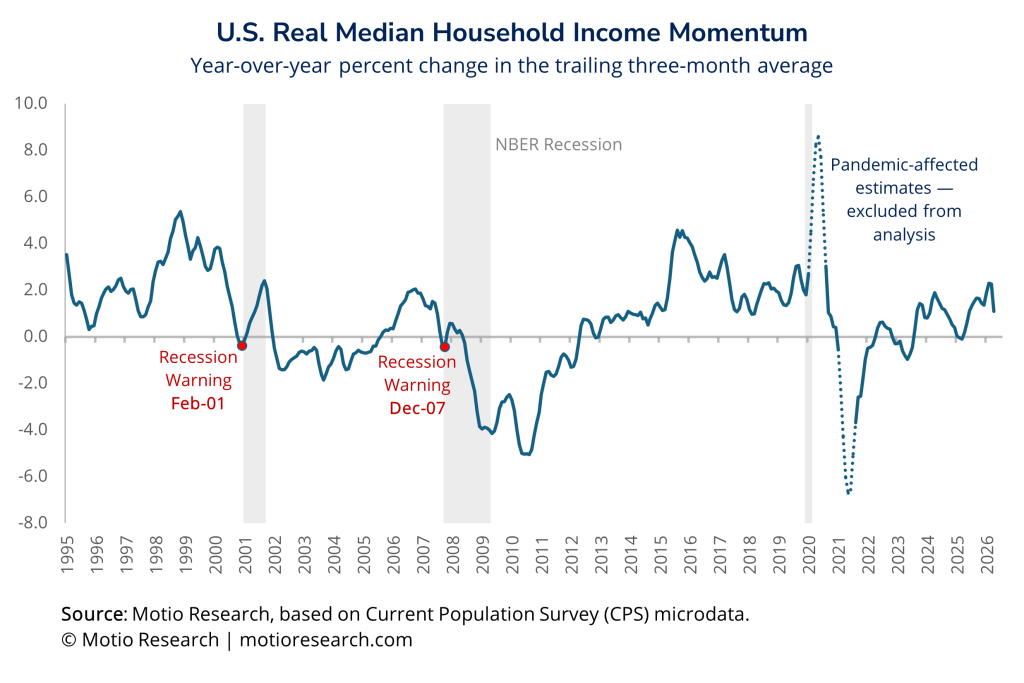
Across this longer historical record, the series shows a clear pattern: sustained positive momentum characterizes household-income expansions, while persistent and sufficiently deep deterioration following a mature expansion preceded the 2001 and 2007–09 U.S. recessions.
The Motio Rule
A U.S. recession warning activates when momentum is negative for two consecutive months and cumulative deterioration reaches at least 0.5 percentage point, following a mature household-income expansion.
A mature expansion is defined as a period of household-income expansion where at least 21 of the most recent 24 momentum readings are nonnegative.
The 2001 and 2007 warnings
The first warning was triggered in February 2001, one month before the NBER’s subsequently determined business-cycle peak. Momentum turned negative in January 2001, and a second negative reading in February brought cumulative deterioration to 0.69 percentage point.
Momentum then remained positive for eleven months—one month short of the cancellation requirement. Deterioration resumed in March 2002, and negative momentum persisted for 43 consecutive months.
The second warning was triggered in December 2007, the same month as the NBER’s subsequently determined business-cycle peak. Following the expansion that reached maturity in September 2007, momentum turned negative in November, and the December reading brought cumulative deterioration to 0.82 percentage point.
A seven-month positive rebound followed, again falling short of the cancellation requirement. Deterioration resumed in August 2008, and negative momentum persisted for 47 consecutive months.
Where things stand now
The post-pandemic household-income recovery has been uneven, but the economy reached a mature household-income expansion in September 2025.
As of June 2026, household-income momentum stood at +1.1 percent. The economy remained in a mature household-income expansion.
June nevertheless brought a sharp loss of momentum. The signal fell from +2.3 percent in May to +1.1 percent in June, the largest one-month decline during a mature expansion in the series to date.
Motio will update the series monthly and report the status of the Motio Rule with each release.