
With the release of the April 2026 estimates, Motio Research is introducing an expanded set of public household income indicators, together with an updated approach to seasonal adjustment and public presentation.
Since launch, Motio’s main public indicator has been the real median household income series: a key timely measure of the economic well-being of U.S. households. That remains our headline series. Beginning with this release, however, we are presenting it in a new way: as a three-month moving average of seasonally adjusted monthly estimates.
This change is designed to make the public series easier to interpret. Monthly household income estimates contain valuable information, but they can also be volatile. Rather than encouraging users to overread isolated month-to-month movements, the three-month trailing average provides a clearer view of the dynamics of U.S. median household income.
At the same time, we are expanding the set of public indicators available to public users. In addition to the headline real median household income series, Motio is now introducing public series for:
- nominal median household income;
- year-over-year changes in real and nominal median household income; and
- the ratio between the 75th and 25th percentiles of household income.
Together, these changes mark an important step in the development of Motio’s household income data. They move our public offering beyond a single headline number and toward a broader, clearer, and more useful view of household income conditions in the United States.
Why we are introducing a three-month average
Economic data released at a monthly frequency often involve a tradeoff between timeliness and volatility. Monthly estimates can provide an early signal of changing conditions, but any single monthly value may also reflect temporary noise, sampling variability, or short-lived disruptions.
This is especially true for household income. Household income is shaped by labor market conditions, hours worked, job changes, household composition, inflation, transfers, and other factors. When measured every month using survey data, the series can move in ways that are informative but also uneven.
For that reason, Motio’s public headline series will now be presented as a three-month moving (trailing) average of the underlying seasonally adjusted monthly estimates. The goal is not to make the data less timely. The goal is to make the signal clearer.
The three-month average smooths some month-to-month volatility while preserving the ability to track recent developments. It allows users to focus less on whether household income moved up or down in one particular month and more on the broader pattern: whether income is rising, weakening, or stabilizing; whether momentum is strengthening or fading; and where the current level stands relative to recent history.
In short, the new public headline series is designed to support a more meaningful interpretation of household income: one centered on level, direction, and momentum.
A broader set of public household income indicators
This release also introduces several new public series that complement the headline real median household income measure.
Nominal median household income shows median household income measured in current dollars, before adjusting for inflation. This series helps users distinguish between changes in household income measured in current dollars and changes in inflation-adjusted income.
Year-over-year changes in real and nominal median household income show how household income compares with the same period one year earlier. These measures provide a useful way to track changes over a longer horizon and reduce the risk of placing too much weight on one-month movements.
The 75th/25th percentile ratio provides a simple measure of income dispersion. It compares household income near the upper part of the distribution with household income near the lower part of the distribution. A higher ratio indicates a wider gap between these two points in the distribution, while a lower ratio indicates a narrower gap.
Each of these series adds a different perspective. The real median series remains the headline measure. The nominal median series shows how household income is evolving in current dollars. The year-over-year measures show the pace of change over a 12-month horizon. The 75th/25th percentile ratio offers a window into income dispersion below and above the median.
Together, they provide a more complete public view of household income conditions in the United States.
Updating our seasonal adjustment approach
Behind these public-facing changes, Motio is also updating its seasonal adjustment method.
Seasonal adjustment is a standard statistical procedure used to remove recurring within-year patterns from monthly economic data. Many economic measures vary throughout the year for reasons that are largely seasonal or calendar-related. Removing those recurring patterns makes it easier to interpret changes over time.
Until now, Motio’s seasonally adjusted series relied on an ARIMA-based X-13 seasonal adjustment specification. Beginning with this release, we are using an automatic X-11 seasonal adjustment approach.
This methodological update affects the seasonally adjusted versions of the Motio household income series. It does not change the underlying household income concept, the source data, or the non-seasonally adjusted estimates. It changes the way recurring seasonal patterns are removed from the monthly data.
Importantly, the main story told by the series has not changed. Since 2010, U.S. real median household income shows a recovery from the 2008–09 recession followed by relatively strong growth through 2020. The pandemic period remains clearly visible in the data, and the post-pandemic pattern continues to show a prolonged period of stagnation through mid-2023, a moderate recovery through mid-2024, relative stagnation through early 2025, and faster growth since then. The updated seasonal adjustment approach refines the monthly path of the series, but it does not alter the broad historical interpretation of U.S. real median household income dynamics over this period.
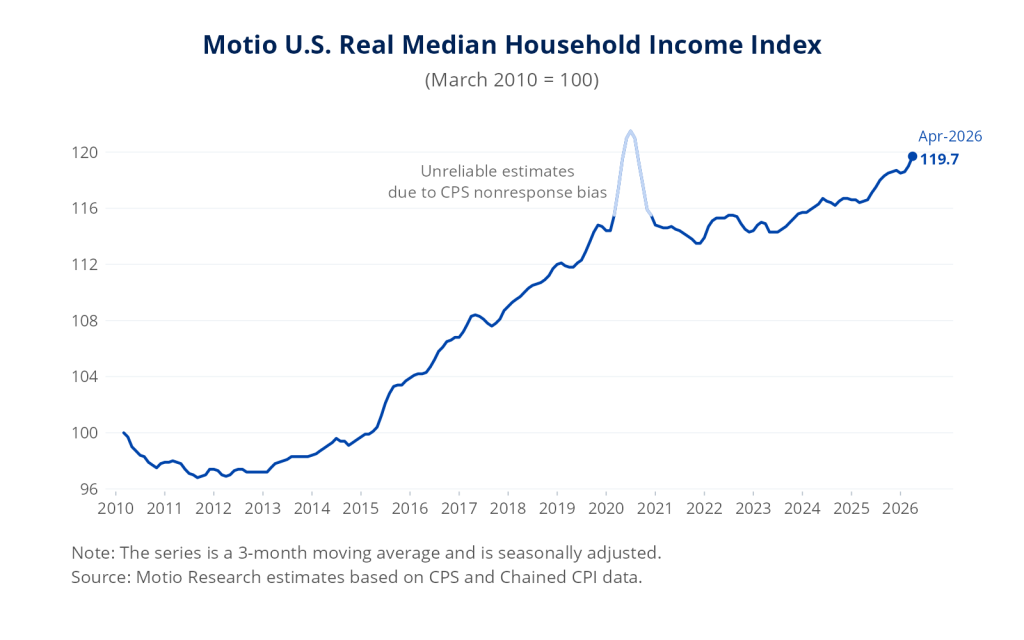
The updated approach gives us a more responsive monthly seasonally adjusted series. That monthly series is analytically valuable, especially for users who want to examine recent movements in more detail. At the same time, greater responsiveness can also mean greater month-to-month volatility.
That is why Motio’s public series will emphasize the three-month trailing average. The underlying monthly seasonally adjusted series provides a timely foundation, while the public three-month average offers a clearer and more stable signal for general interpretation.
A Clearer Public Signal
The purpose of this release is to improve both the statistical foundation and the public presentation of Motio’s household income indicators.
The updated seasonal adjustment approach provides a more responsive monthly foundation. The new public three-month average makes the headline series easier to interpret. The expanded set of public indicators adds context across real income, nominal income, year-over-year changes, and income dispersion.
Together, these changes support a clearer reading of household income conditions in the United States.
The principle is simple: timely data are most useful when the signal is disciplined, comparable, and clear.
Going forward, Motio’s public household income series will place less emphasis on isolated month-to-month movements and more emphasis on the level, direction, and momentum of household income over time.